Why the Mahindra Thar became India's most unlikely cultural flashpoint
Everyone has an opinion on the Mahindra Thar, and most of them are about the driver rather than the SUV. We explore how class, geography and performative masculinity shaped its image, why more women are giving the Thar a very different identity, and what Mahindra could do to change the conversation around India's most misunderstood SUV.

There is a particular silence that falls over a Delhi roundabout when a modified Mahindra Thar approaches. It is not the silence of respect. It is the silence of calculation. The kind every smaller car, two-wheeler and pedestrian performs instinctively.
Will this one stop, or will I have to?
That calculation plays out countless times each day across Delhi NCR, Haryana, Rajasthan, and western Uttar Pradesh, making it tempting to dismiss the Thar as a peculiarly North Indian phenomenon. The evidence suggests something more nuanced.
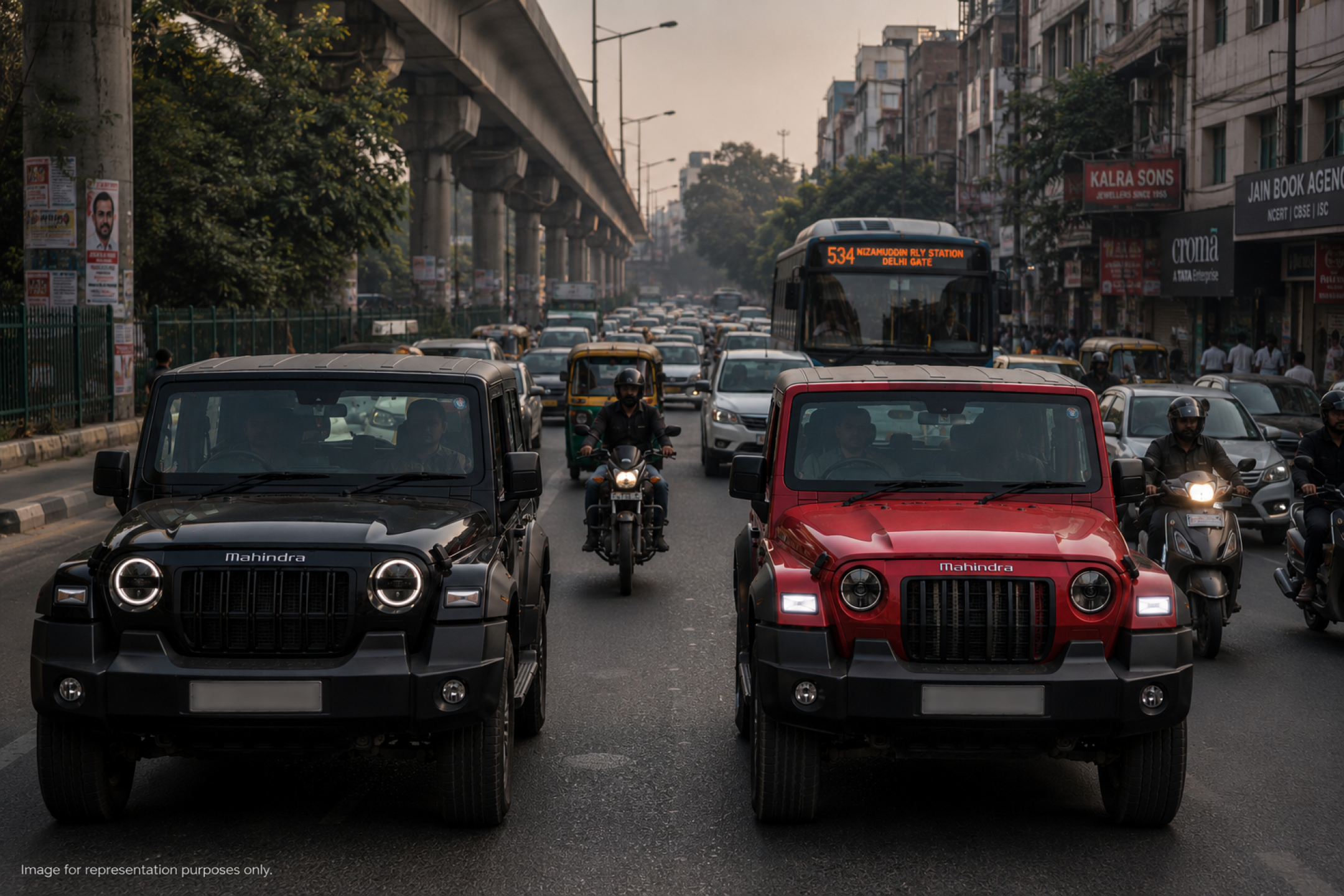
Last year, Haryana's Director General of Police remarked that people who drive a Thar "must be crazy", describing the vehicle less as a mode of transport than a public statement of identity. Yet around the same time that videos of Thar-fuelled road rage were circulating from Noida and Delhi, another Thar crashed into a bus while driving on the wrong side of a highway in Kerala. There was a road-rage incident in Bengaluru, and tourists from across the country drove Thars into protected lakebeds in Ladakh. This week, Goa's transport minister announced plans to stop issuing new rental licences for Thars after a spate of crashes.
The behaviour is national. What varies by region is its concentration, and the social conditions that produce it. The more interesting question is not why this behaviour exists, but why the Thar became its most recognisable expression. Perhaps the answer lies in the stories Indians have long told themselves about land, power, status and masculinity.
A vehicle in search of a villain
As a piece of engineering, the Mahindra Thar is an accomplished machine: a genuine 4x4 with serious off-road ability. Comfort, however, has never been its primary concern, whether for its occupants or those sharing the road with it. Its design traces back to the original Jeep, while its unapologetically boxy proportions and structural character have made it one of the few Indian vehicles to acquire a cultural identity far beyond its intended purpose.
None of what follows is an argument against the machine. It is about what happens when a machine acquires a social meaning its creators never envisioned.
The land-owning inheritance
To understand why the Delhi NCR belt produces such a visible share of Thar theatre, one must first understand the social landscape it drives through. This is a region where land, more than liquidity, has traditionally been the measure of status. Haryana, western Uttar Pradesh and rural Punjab still carry the cultural memory of the zamindar, the landholding patriarch whose authority over his own land was, for all practical purposes, unquestioned.
That authority did not disappear with land reforms. It evolved. First into the tractor, as much a symbol of ownership as a farming tool. Then into the SUV, as agricultural wealth flowed into real estate, weddings and increasingly, vehicles built to command attention. Mahindra's Scorpio arrived first, becoming the vehicle through which this aspiration moved from the farm to the highway. The Thar came later, at a time when the same desire was looking for a more lifestyle-oriented expression.
For some families who sold ancestral land to expanding cities, there remained a lingering psychological claim to what had once been theirs. The land may have changed hands, but the memory of ownership did not. The Thar became, for some, a visible reminder of that lost ground, a way of saying that the family had not surrendered its place in the hierarchy, only transformed it. Its height, visual mass and unmistakable language of dominance did the rest. It could travel from a farm in Jhajjar to a nightclub in Gurugram without changing character. Only the audience changed.
This, however, is not uniquely a North Indian story.
Andhra Pradesh, Kerala, Karnataka and parts of Maharashtra have their own traditions of automotive machismo rooted in older hierarchies. But the northern belt's incidents often carry a distinct flavour of entitlement, the sense of someone defending what they believe is their place in the social order.
Status without subtlety
Every society has its symbols of quiet status and its symbols of conspicuous status. The Thar phenomenon, particularly among its more theatrical owners, belongs firmly to the latter. It reflects a grammar of wealth in which status is only meaningful if it is seen, preferably by someone in a smaller vehicle from behind the wheel of a taller one.
Behavioural researchers have long observed that occupants of larger vehicles tend to drive more aggressively, in part because physical dominance lowers the perceived social cost of rudeness. The modifications favoured by this subset of owners make that logic impossible to miss. Suspension lifts with little purpose on tarmac. Tyres stretched well beyond factory specifications, chosen less for grip than for the silhouette they create in a rear-view mirror. Exhausts engineered to be heard long before the vehicle is seen. None of it adds meaningful capability. It is designed to broadcast.
The psychology of the unearned high ground
There is a well-documented behavioural effect at work here. A higher driving position and greater vehicle mass can foster a greater sense of entitlement to road space. Sit six inches above everyone else in a vehicle twice the weight of the hatchback beside it, and the brain quietly recalibrates its idea of who has the right of way.
Place that in a culture where masculine identity has long been performed through visible displays of strength, whether in wrestling akhadas, wedding processions or political rallies, and the Thar becomes the automotive equivalent of a permanently puffed-up chest and flexed biceps. The tragedy is that this performance has real victims. Delhi and the NCR have produced no shortage of incidents showing Thars used less as vehicles than as instruments of intimidation. These are not the actions of adventurers. They are the actions of people who mistake a driving licence for a licence to dominate.
A different driver, a different story
It would be a disservice to end there, because the Thar has acquired a second, far more heartening identity in recent years: the woman behind the wheel. A growing number of women across Indian cities and towns have embraced the Thar precisely because it refuses to disappear into traffic. For many, it is less an instrument of intimidation than a marker of independence, a way of occupying public space with confidence after years of being expected to stay out of the way.
That distinction matters. Confidence and aggression can look similar from a distance, but they reveal themselves very differently up close. One makes room. The other demands it.
If the Thar is to be redeemed as a cultural symbol, it may well be women drivers, not manufacturers or regulators, who lead that change. They demonstrate that commanding a large vehicle does not require dominating everyone else on the road.
What Mahindra could do about it
Mahindra did not design the Thar to become a symbol of insecurity, nor can it police the psychology of every buyer. But brands inevitably shape the cultures that grow around their products, and Mahindra has more influence over the Thar's image than it may realise.
It could begin by taking a far stronger public position on modifications that are not merely aftermarket but illegal. Oversized tyres that fall outside regulations, unauthorised exhausts, lift kits that compromise safety or violate certification. A brand with the Thar's cultural reach stating unequivocally that a road-illegal Thar is not representative of the brand would carry more weight than another traffic advisory.
It could also invest more deliberately in the ownership culture it wants to encourage. That means celebrating women owners not as a token gesture, but because they embody a version of Thar ownership defined by confidence rather than intimidation. It also means championing the growing community of urban professionals who use the Thar for what it was built to do: escaping the city on weekend trails, exploring the outdoors and enjoying responsible off-roading. Mahindra should expand owner communities, trail etiquette programmes and curated adventure experiences that reward skill over spectacle. And it should partner with traffic authorities on road safety campaigns that remind owners that the Thar's capability is best demonstrated off the road, not on public streets.
None of this requires Mahindra to apologise for the vehicle. It requires drawing a clear line between the machine it engineered and the myth that has grown around it. The former deserves admiration. The latter deserves to be challenged. The choice of which story defines the Thar is one Mahindra still has the opportunity to influence.
The real off-roading challenge
The most difficult terrain the Thar will ever cross is not a riverbed in Ladakh or a dune in the Rann. It is the ordinary Tuesday morning commute, where the real test of character is whether a driver can share the road without feeling the need to own it.
Until that lesson is taken seriously by owners, by law enforcement and by Mahindra itself, the Thar will continue to represent two very different ideas. One is freedom, adventure and the joy of exploring beyond the tarmac. The other is entitlement disguised as confidence. Which of those identities endures will depend less on the vehicle than on the people who choose to define it.